Guide
Cove lighting: design, dimensions and common mistakes
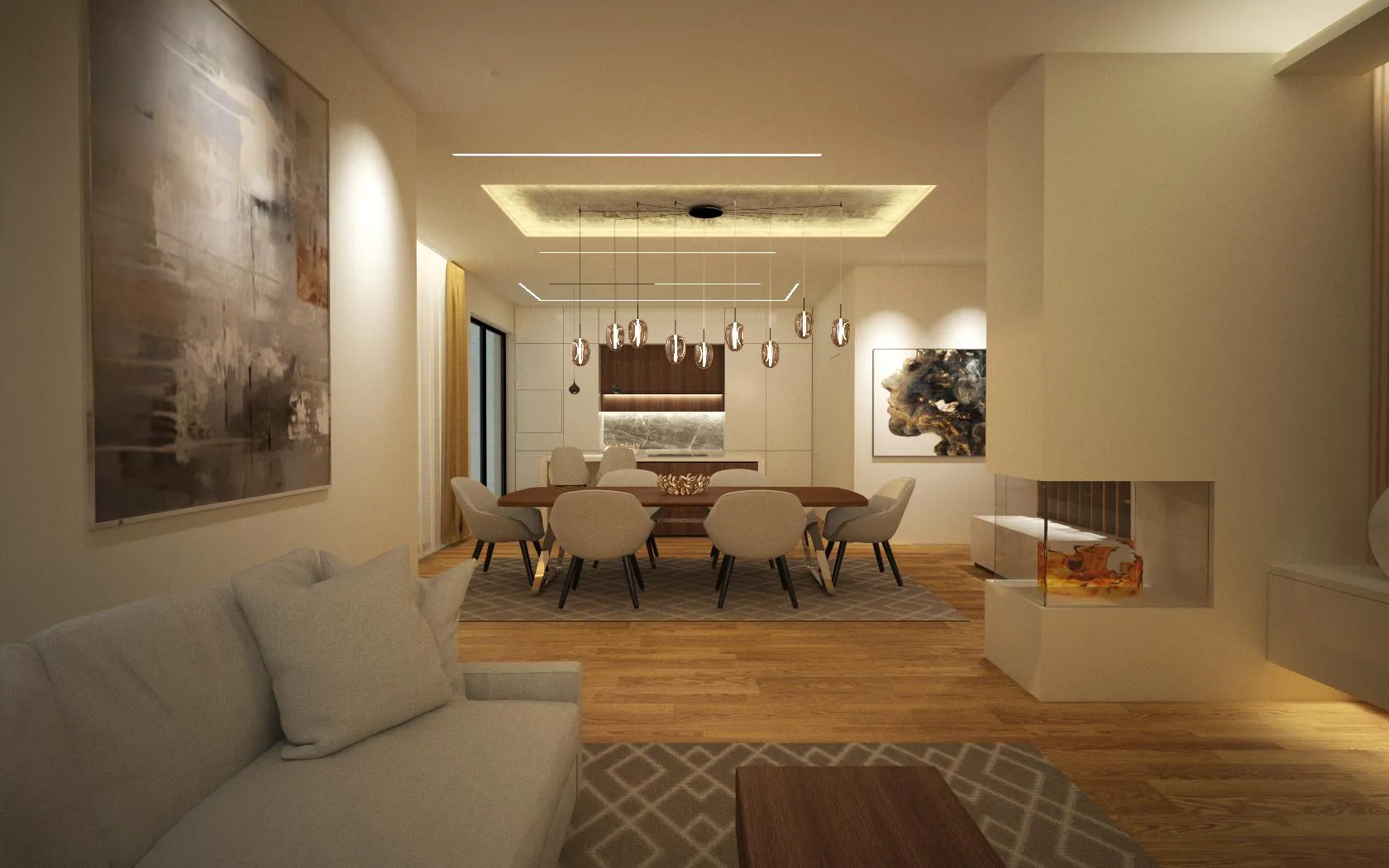
In short
Cove lighting is a concealed line of LED light in a ceiling or wall recess that reaches the room indirectly via a reflecting surface. For it to glow evenly, its position, profile, distance to the ceiling and LED strip must be decided before the drywall goes up. The more distance the light has to the surface it washes, the softer the gradient.
What is cove lighting?
Cove lighting is a light source concealed in an upstand or recess in a ceiling or wall. The light first hits a surface, usually the ceiling, and then falls softly into the room. The room feels taller and calmer because no luminaire causes glare.
The term comes from architecture: a cove is the curved transition between wall and ceiling, and in historic plaster ceilings a hidden light source often sat there. Today an LED strip does the job, and the cove is built in drywall, from a ready-made profile or from a moulding.
Typical places for cove lighting:
- around the perimeter of a ceiling in a living or dining room,
- around a dropped ceiling panel, for example above a dining table or in a hallway,
- on a wall as a horizontal line of light, behind a TV or above a bed,
- on stairs and handrails, where the light illuminates the steps without glare.
How is a drywall cove built?
A drywall cove consists of a metal stud framework, plasterboard lining and an upstand that hides the LED strip. Instead of cutting the cove from boards, many contractors use prefabricated plasterboard cove elements. For retrofits there are aluminium and rigid foam profiles that are glued in place and painted over.
The order on site:
- framework on ceiling and wall,
- cables, feed points for the LED strip and space for drivers,
- lining and cove elements,
- filling, sanding and painting,
- inserting and connecting the LED profile and strip.
The LED strip goes in last. If it is installed before painting, paint splashes end up on the light source.
What dimensions does cove lighting need?
The dimensions follow from the desired effect, the ceiling height and the viewing angles of people in the room. The values below are guide values from practice. For your room, we define them in the lighting concept and check them against the profile manufacturer’s data.
| Design parameter | Guide value | Why |
|---|---|---|
| Distance from LED to the lit surface | about 8–15 cm for a soft wash, less for a sharper line | More distance gives a softer gradient without a hard edge |
| Cavity depth in drywall | about 10–15 cm | Space for profile, LED strip and cables |
| Height of the upstand | high enough that the LED is not visible from any seat or standing position | No visible dots, no glare |
| Ceiling height | the indirect effect works well from about 2.50 m | In low rooms, linear or recessed lights are often the better choice |
| LED density | high-density or COB strip that reads as a continuous line | Even wash instead of visible dots |
| Luminous flux | about 200–800 lm per metre as mood light, 1,000 lm per metre and more as ambient light | Indirect light loses part of its brightness at the surface |
| Colour temperature and rendering | warm white around 2,700 K, Ra ≥ 90 | Homely light, natural colours of walls, wood and fabric |
| Driver | accessible behind an access panel, several feed points on long runs | Maintenance without opening the ceiling, even brightness along the whole length |
lm = lumen, the amount of light emitted by the LED strip. K = kelvin; the lower the value, the warmer the light. Ra describes how natural colours look under the light.
Cove, shadow gap, moulding or linear light: which fits when?
Coves, shadow gaps and LED mouldings all produce indirect light but differ in effect, space required and effort. Linear lights are the direct alternative.
| Solution | Effect | Suitable for | Effort |
|---|---|---|---|
| Drywall cove | wide, soft wash across ceiling or wall | Living spaces from about 2.50 m, dropped ceilings, new builds and refurbishments with drywall | high, must be planned before the drywall |
| LED shadow gap | narrow, precise line where wall meets ceiling | Minimal, modern rooms, including lower ceilings | medium, profile before plastering |
| LED moulding | subtle light from a profiled moulding | Period homes and retrofits | low, glue and paint |
| Linear light (recessed profile) | direct, directional line | Hallways, kitchens, worktops | medium |
The six most common cove lighting mistakes
Most cove lighting mistakes are not made during installation but because nobody decided beforehand how the light should look. They only become visible once the ceiling is finished.
- Too little distance to the ceiling. Instead of a soft wash, you get a harsh stripe with a hard edge.
- Visible dots of light. The LED density is too low or the upstand too short. The strip reflects in glossy surfaces and windows.
- The ceiling shows every imperfection. Grazing light reveals filler edges. For surfaces lit by a cove, specify a high finish quality before the work starts.
- The driver is installed but inaccessible. If it fails, the ceiling has to be opened.
- The cove is expected to do everything. As the only light source it looks flat and is too weak for reading, cooking or working.
- Gaps in the corners and the wrong colour. If the strip stops before the corner, a dark patch appears. Cool light or poor colour rendering makes walls look pale.
What must be decided before the drywall goes up?
Position, length and type of the cove must be decided before the drywall, because changes afterwards are costly. These points belong in the construction drawings for the drylining contractor and electrician:
- position and length of each cove, continuous around corners,
- construction: drywall, prefabricated element or ready-made profile,
- distance to the ceiling and height of the upstand,
- cables, feed points and driver locations with access panels,
- switching and dimming, coordinated with the other lighting in the room,
- finish quality of the lit surfaces.
In practice: lines of light in a private residence near Lahr
For a family residence near Lahr in Germany’s Black Forest, AK Lichtdesign designed the lighting for all interior rooms. Indirect lines of light set the basic mood, while precisely placed spotlights emphasise materials and furniture. In the hallway, a perimeter cove frames the ceiling panel; in the stairwell, a line of light runs along the wall.
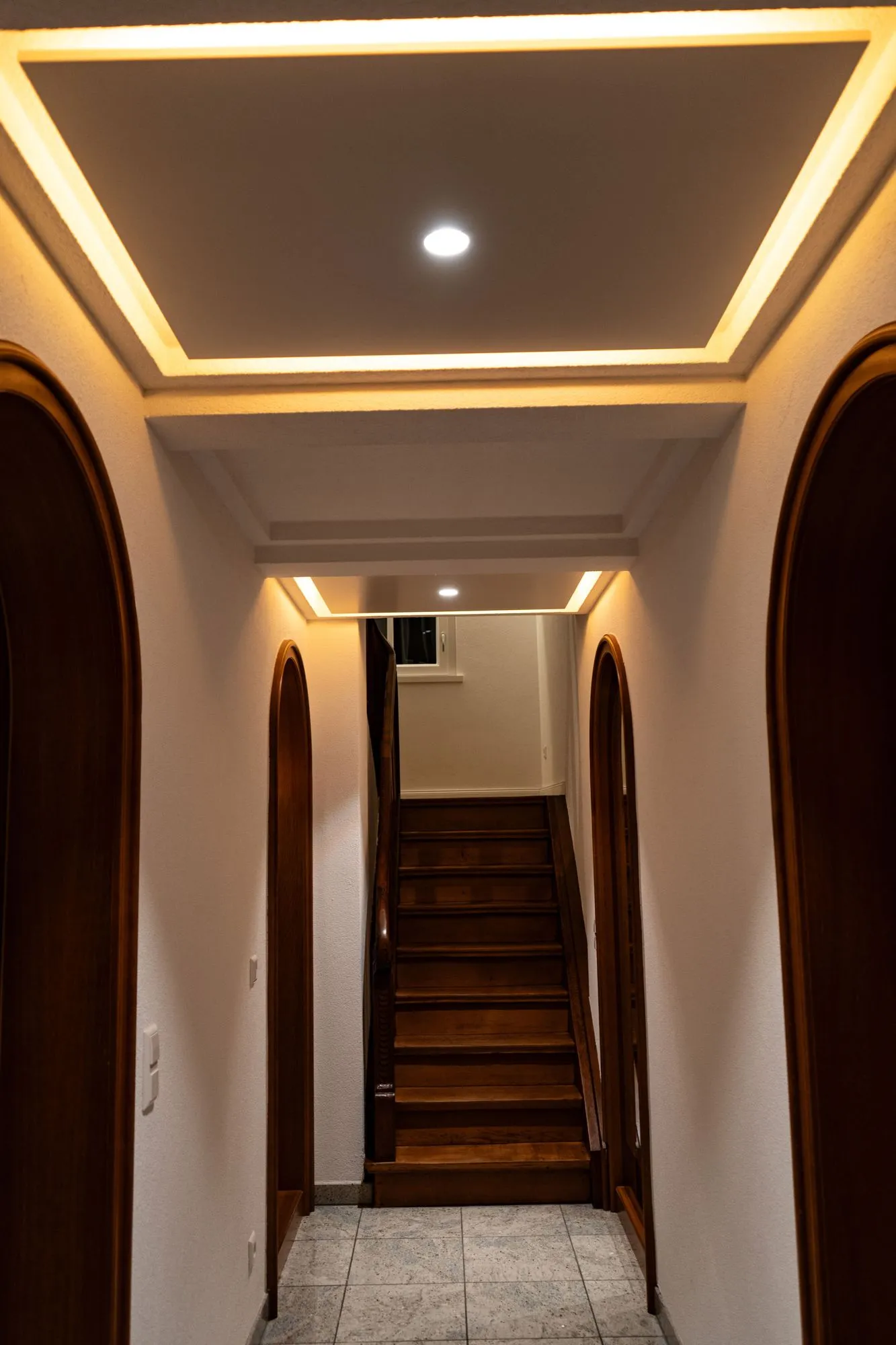
Before construction, visualisations showed the effect of the lighting moods so the family could decide with confidence. During implementation, AK Lichtdesign supervised the work on site. See the project
When a lighting designer is worth it for cove lighting
A lighting designer is worth it as soon as a cove is part of the room rather than a profile glued in afterwards. A cove is built architecture: whatever sits wrong in the drywall stays wrong.
In our home lighting design we decide where indirect light works and where task or accent light is needed. Drylining contractors and electricians receive construction drawings with positions, dimensions and switching groups, and the specified LED profiles come from one source. The lighting design process shows the six phases in detail. For a first assessment of your plans, book a free lighting consultation.
Frequently asked questions
Frequently asked questions
How much does cove lighting cost?
It depends on length, construction and LED technology: drywall or ready-made profile, LED strip, drivers and controls, plus the work of the drylining contractor and electrician. Flat prices per metre are therefore misleading. In the lighting concept we estimate the material costs for your project before anything is built.
How wide and deep should a cove be?
Large enough for the profile, LED strip and cables, and deep enough that the LED cannot be seen from the room. In drywall construction, cavities about 10 to 15 centimetres deep are common. The exact dimensions depend on ceiling height, viewing angles and the desired effect.
What are the disadvantages of indirect lighting?
Indirect light on its own quickly looks flat and is usually not enough for reading or cooking. It needs more power than direct light because some light is lost at the reflecting surface, and it reveals any unevenness in ceilings and walls. That is why cove lighting is one layer in a lighting concept, complemented by task and accent lighting.
Which colour temperature suits cove lighting in a living room?
Usually warm white around 2,700 kelvin. In the evening, LED strips that become warmer as they dim feel particularly homely. Look for colour rendering of Ra 90 or above so that wall colours, wood and fabrics look natural.

About the author
Andreas Kistner
Andreas Kistner is a lighting designer and owner of AK Lichtdesign in Offenburg, Germany. With more than 30 years of experience and over 500 international projects, he designs lighting for private homes, architecture, hotels and restaurants, from concept to final acceptance.
More about AK Lichtdesign →Free project call
Planning a project? Let's talk.
By video, by phone or in our showroom in Offenburg. After your enquiry, we will get back to you with suggested dates.
- Phone
- +49 781 12559932
- Showroom
- Franz-Volk-Straße 5A, 77652 Offenburg, Germany